Shailen Saikia
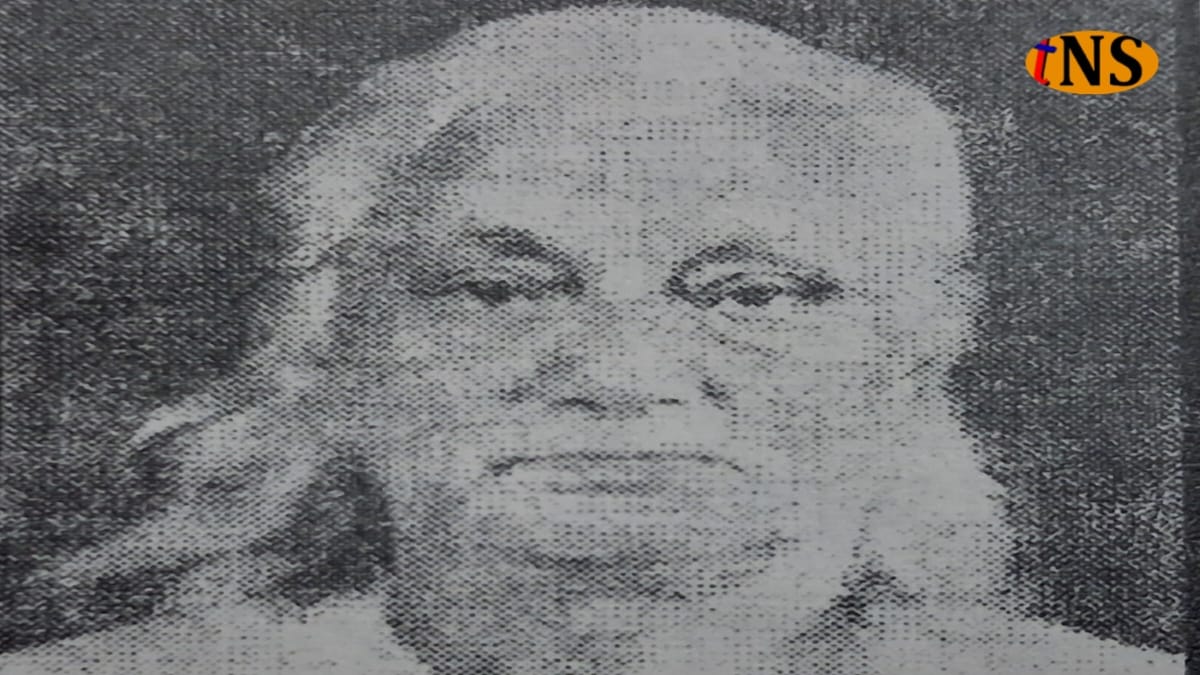
Lokasevak Haladhar Bhuyan, a freedom fighter, a friend of the poor, and a social worker who devoted his entire life to the upliftment of the underprivileged, worked tirelessly for the progress of society and actively promoted the ideals and culture of Mahapurush Srimanta Sankardeva (Lokasevak Haladhar Bhuyan). He contested the legislative assembly elections held in 1937 and 1946 and was elected MLA consecutively twice. Living the life of a common man and driven by his desire to work for the welfare of society, he even rejected the invitation to accept a ministerial position in the cabinet of the popular leader Gopinath Bordoloi.
Haladhar Bhuyan was born on 28 September 1891 in Tetelisora, Kampur in Nagaon district. His father’s name was Babul Bhuyan. He began his education at Kampur M.V. School and passed the matriculation examination from Nagaon Government High School in 1914. After that, he enrolled at Cotton College in Guwahati. However, due to financial difficulties in the family, he had to discontinue his studies midway and return home. After returning, he first worked as a copyist in the Nagaon court and later took up a clerical job at the Nagaon Civil Surgeon’s office.
In 1921, when the Non-Cooperation Movement began across the country, he joined the movement and consequently had to leave his job. After entering public life as a volunteer of the Indian National Congress, he remained engaged in social work for the rest of his life. He was the first General Secretary of the Nagaon District Congress. Haladhar Bhuyan was a person of exceptional character.
So great were his contributions that tallying his unfinished tasks would be a far shorter exercise than listing his achievements. Because of his participation in the freedom movement, it is difficult to determine exactly how many times he was imprisoned.
He established the Congress office in his own house in Nagaon town. While actively participating in the freedom movement, he did not limit himself to delivering speeches at Congress meetings in villages and towns; he also encouraged people to become self-reliant. To support his family, he worked as a grocery shopkeeper, private tutor, life insurance agent, newspaper agent, and practitioner of herbal medicine.
During the freedom movement, Haladhar Bhuyan’s house served as a shelter and dining place for Congress leaders and volunteers. In the elections of 1937 and 1946, he contested as a candidate of the Indian National Congress from the Nagaon West constituency and was elected twice consecutively to the Assam Legislative Assembly. While serving as MLA, he became the Secretary of the Congress Legislative Party in 1948. Later, he left the Congress and in 1952 became the President of the Assam State unit of the Praja Socialist Party. At that time he maintained close relations with many prominent political leaders of Assam.
His social work was not confined only to Nagaon district; the entire Assam and the North-Eastern region formed his field of service. He was also one of the founders of the Srimanta Sankardeva Sangha, which was established in Nagaon in 1929 and is now the largest religious and cultural organization in Northeast India. He served as its president from 1930 to 1933. Inspired by the ideals of Mahapurush Srimanta Sankardeva since his youth, Haladhar Bhuyan established a voluntary organization named Srimanta Sankar Mission in Nagaon in 1950. This organization served the needy of society by establishing the first eye hospital and the first school for the blind in Northeast India, along with a tuberculosis treatment hospital.
He also made notable contributions to the establishment of Gauhati University, Assam Medical College in Dibrugarh, and Assam Veterinary College in Guwahati. In 1964, the Rajnoitik Nirjatita Mancha honoured him with the title “Lokasevak.” Haladhar Bhuyan, a simple-living social worker, skilled politician, and a man of many talents, passed away on 28 March 1968.
Memorable Anecdotes from the Life of Lokasevak
After passing matriculation, Haladhar Bhuyan enrolled in Cotton College in Guwahati. In the same hostel he lived with students like the eminent scholar Pandit Krishnakanta Handique, Natya Acharya Indreshwar Barthakur, and Bhaven Das. For amusement, they once set up a mock “university” in the hostel. Krishnakanta Handique became the Vice-Chancellor, while Haladhar Bhuyan served as the Controller. Every night after dinner they held sessions of the mock university’s senate. Handique would deliver speeches while the others listened.
In 1952, Haladhar Bhuyan became the president of the Assam State branch of the Praja Socialist Party. In his presidential address at the party’s state conference in 1953, he said:
“In August 1947, a divided India achieved self-governance and power came into the hands of the Congress Party. But what did the people actually gain under Congress rule? It must be said with great sorrow that instead of the Ram Rajya envisioned by Mahatma Gandhi, founded on truth and non-violence, people witnessed injustice, immorality, corruption and oppression under the Congress government. Gandhi himself had advised dissolving the Congress and establishing a ‘Lokasevak Sangha’, but who listened?”
Prominent freedom fighter and Congress leader Bijoy Chandra Bhagawati once wrote about Haladhar Bhuyan:
“Among the small number of leaders and workers who remained ideologically committed to the methods of production and political struggle both during the freedom movement and after independence, Loksevak Haladhar Bhuyan was one of the most notable. In various phases of India’s freedom struggle and in the years after independence, he demonstrated remarkable organizational and leadership abilities.”
In the Assam Legislative Assembly in 1937, there was a debate regarding a proposal raised by a Muslim League MLA to abolish the Line System, which had been implemented by the government to protect the land rights of indigenous farmers. Participating in the debate, MLA Haladhar Bhuyan opposed the proposal and said:
“To explain this, I give an example from the Ramayana. When Lakshman drew a line around Sita during their exile in the forest and asked her not to cross it, that was a ‘line of honour.’ The line that exists between the Mymensinghias and the Assamese is also nothing but a ‘line of honour.’” (Published in the Assam Gazette).
Translated By Nayan Jyoti Borah.
Mohammad Idris: The First MLA of Rupohihat and a Life of Quiet Public Service