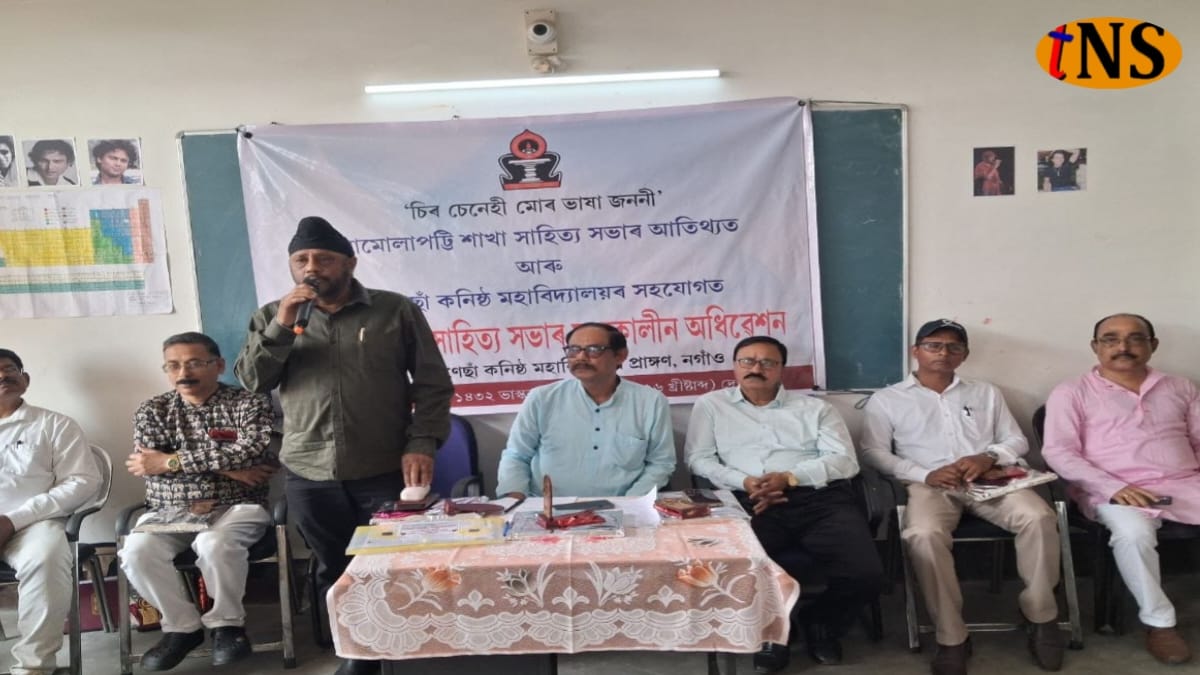
Safiqur Rahman: The mid-term session of the Nagaon District Sahitya Sabha was successfully held on Sunday at the premises of Renaissance Junior College, with Amolapatty Branch Sahitya Sabha as the host and Renaissance Junior College as the collaborating institution (Nagaon District Sahitya Sabha). The representative meeting was presided over by Nagaon District Sahitya Sabha President Dr. Sarat Barkotoky and inaugurated by noted litterateur-journalist Gurmail Singh.
In his inaugural address, Gurmail Singh highlighted the immense role of the Asam Sahitya Sabha in shaping the social and cultural life of Assam for over a century. He remarked that the literary body has deeply influenced people across all sections of society. Referring to the discussions and occasional criticisms surrounding the organization, Singh said that whenever even a minor irregularity occurs within the Sahitya Sabha, it often attracts media attention. However, he noted that such criticism usually comes from genuine admirers who wish to see the institution remain strong and vibrant.
Addressing the representatives, Singh further said that the Sahitya Sabha has given many individuals a platform, identity, and dignity in society. He urged members to contribute according to their abilities to strengthen the organization. Emphasizing inclusivity, he stated that the platform of the Sahitya Sabha should remain open not only to established writers but also to all those who love literature and engage in literary practice. He also stressed the importance of strengthening the branch committees of the Sabha.
The meeting was conducted by District Sahitya Sabha Secretary Rajiv Kumar Hazarika, who also explained the objectives of the session. In his presidential address, Dr. Sarat Barkotoky observed that in the present digital era, the avenues for the promotion and dissemination of knowledge, literature, and culture have expanded significantly. Consequently, the responsibility of the Sahitya Sabha has increased manifold. He emphasized that establishing the Assamese language and literature strongly on digital platforms should be a major priority.
Dr. Barkotoky pointed out that many valuable books, manuscripts, and research works still remain confined to printed pages. According to him, preserving such resources in digital formats and making them available online has become the demand of the time. He also stressed the importance of connecting the younger generation with literature, noting that today’s youth are highly active on mobile devices, the internet, and social media. Therefore, he suggested that the Sahitya Sabha should use digital platforms, online discussions, and e-magazines to encourage literary engagement among young people.
He further highlighted the need to maintain the correct usage and standard form of the Assamese language in the digital age and urged the organization to create awareness against the misuse or distortion of the language on social media. Dr. Barkotoky also underlined the importance of building digital archives and information repositories for Assamese literature.
Former President of the Nagaon District Sahitya Sabha Thagit Mahanta spoke about the responsibilities and duties of the organization, while Rebat Kumar Hazarika, Secretary of the Nagaon Regional Office of Asam Sahitya Sabha, elaborated on the role of the literary body and praised the session as constructive and meaningful. Assistant Secretary Mriganka Bora expressed concern over the weak functioning of some branch units of the Sahitya Sabha. The secretary also presented the annual report during the meeting.
A number of important resolutions were adopted during the session. The Sabha welcomed initiatives such as e-books, online literary portals, digital magazines, and digital archives to make Assamese literature more accessible in the digital age.
Significantly, the district body proposed launching a reading campaign titled “One Book a Month” with the aim of cultivating reading habits in society. Under the initiative, members will have the opportunity to briefly present and discuss the books they read during the monthly meetings of the Sahitya Sabha.
The meeting also resolved to encourage research and the publication of new books on Assamese language, literature, history, and culture. Expressing concern over spelling errors in place names written on signboards by the National Highways Authority in different parts of the district, the representative meeting urged authorities to ensure correct Assamese spelling on all signboards.
The session also adopted resolutions regarding necessary action against inactive branch committees of the district Sahitya Sabha.
Among those present at the meeting were Asam Sahitya Sabha Vice-President Padum Rajkhowa, Renaissance Junior College Vice-Principal Bichitra Narayan Saikia, and district office bearers including Dr. Hemanta Kumar Goswami, Mahesh Chandra Nath, Surajit Goswami, Jiten Barkotoky, Manoj Kumar Sharma, Abhijit Sharma, and Khagen Chandra Nath, along with many other representatives.
The programme began with the ceremonial hoisting of the Sahitya Sabha flag by President Dr. Sarat Barkotoky and a floral tribute offered by Vice-Principal Bichitra Narayan Saikia. Members of the women’s wing of Amolapatty Branch Sahitya Sabha presented the song “Chir Chenehi Mor Bhasha Janani.” A moment of silence was also observed in memory of the late Dhirendranath Chakravarty, Dr. Dhiren Borkakati, and Achfia Sultana.
Representatives and office bearers attending the session were felicitated with books and mementos by the reception committee. A special resolution of gratitude was passed in honour of Renaissance Junior College Principal Parthajit Baruah, while session coordinator Priyanku Sharma was felicitated for his efforts in organizing the programme successfully.
Basanta Milan Utsav Brings Colourful Cultural Performances to Rabindranath Tagore University, Hojai