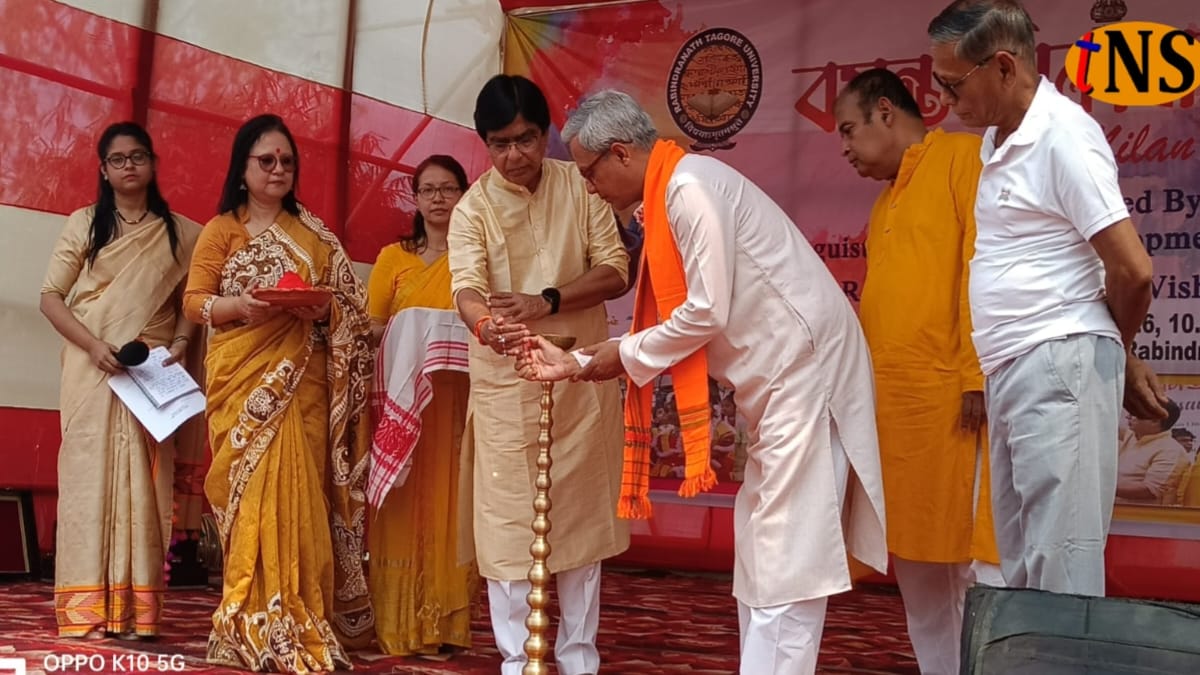
Hojai: The campus of Rabindranath Tagore University in Hojai came alive with colour and culture as it hosted the ‘Basanta Milan Utsav’ — a vibrant spring festival steeped in tradition. The open-air stage at the Botanical Garden within the Srimanta Sankardeva premises of the university became the heart of the festivities on Saturday (Basanta Milan Utsav). Jointly organised by Rabindranath Tagore University and the Minority Linguistic Development Council, the event has been a recurring celebration, and this year was no different — carried out with the same warmth and grandeur that has come to define it.
Lamp Lighting and the Opening of Cultural Proceedings
The festival was formally inaugurated by university Vice-Chancellor Professor Manavendra Dutta Choudhury and Minority Linguistic Development Council Chairman Shiladitya Dev, who lit the ceremonial lamp together. The moment the flames rose, the cultural programme swept through the entire premises. Sujan Das and Ashirbani Kar opened the evening with devotional Hari Geet, drawing the gathering into a quietly spiritual mood before the stage shifted gears entirely.
What followed was a sweeping, joyful tour through Assam’s folk traditions. Borul Bora’s troupe performed Bhortal dance. University students then took over — presenting Braj Holi, Barpetiya Holi dance, Manipuri dance, Dimasa dance, Karbi dance, and Sattriya dance, one after another, each holding the audience’s attention in a way the last had. Beyond the students, artists from Malyashree Nritya Vidyalaya of Guwahati and Tarangini Nrityalaya of Hojai added further depth to the evening. Singer Suparna Banik’s melodious performances and cultural presentations by students of Lumding College rounded things out.
A Confluence of Tribal and Folk Arts
The festival also made room for something rarer — a Manipuri Holi group dance performed by artists from a Manipuri women’s cultural organisation. Artists from the Tribal Cultural Mahasabha showcased Bagurumba, while cultural performers from Lanka demonstrated Dhammail dance. Taken together, these acts turned the venue into something close to a living map of the region’s cultural diversity.
The entire programme was coordinated by Dr. Parismita Hazarika, Assistant Professor in the History Department of the university. Gautam Sharma, writing on behalf of the university, informed the media that the rare convergence of music, dance, and tradition from so many different communities gave the assembled audience a genuinely joyful evening.