Devashish Sharma (IAS) DC Nagaon:
The great saint Srimanta Sankardev, born in 1449, staged the historic Chihna Yatra Bhaona in 1468 at the age of about nineteen. Painting the symbolic scrolls of the seven Vaikunthas, composing verses and devotional songs for the play, and accompanying the performance with the rhythmic beat of the khol, he brought about a cultural revolution in Assam — one that reached far beyond the stage and into the spiritual life of the people (Bordowa Doul Festival 2026).
According to the Charit Puthi, after Sankardev accepted the title of Shiromoni Bhuyan, the fellow Bhuyans who supported him came forward with a singular wish: they wanted to behold Vaikuntha. His answer was not doctrinal. He gave them Vaikuntha through the Chihna Yatra Bhaona itself. Ramcharan Thakur records the moment in the Guru Charit:
“Tomashar bakya / satye satye dekhaibo Vaikuntha par / Chihnayatra name koribo bektat / harish paiba prachur”
(“By your words, I shall truly and truly show Vaikuntha; through a performance named Chihna Yatra, you shall attain abundant joy.”)
Alongside organising the Chihna Yatra, Sankardev constructed a Doul temple and observed the Phakuwa — the Phalgu festival — on the full moon night of Fagun. The Charit Puthi records:
“Dakshine jatrar Doul Shankare nirmila / Sato Vaikunthar chihna aankiya dekhaila”
(“To the south of the Yatra, Sankar built the Doul and depicted the signs of the seven Vaikunthas.”)
The construction of the Doul temple is described with quiet vividness by Ramcharan Thakur:
“Kor chhangi hate dhori / bandhi lanta rong kori / joto Bhuyangane mati dila / ehimate Doul bhoil / Bhuyan gan ghore goil / Shankareyo harish bulila”
(“Holding hoes or spades in their hands, they built it joyfully, as the Bhuyans offered soil; thus the Doul came into being, the Bhuyans returned home, and Sankar rejoiced.”)
The Charit Puthi further records:
“Tamrar patrat kori Srimanta Shankardev eko pachi mrittika dilanta / sehi mrittikak thapi Krishnar murtikak puji Doul Yatra ronge korilanta”
(“In a copper vessel, Srimanta Sankardev placed a basketful of earth; installing it, he worshipped the idol of Krishna and celebrated the Doul Yatra with joy.”)
On the full moon day, Sankardev observed the Phalgu festival at the Doul temple and applied faku to Govinda Gosai. The Kirtan records:
“Phalgunit Govindak tuliya Doulot / Doul Yatra kore mahotsav sibelat”
(“In Phalgun, Govinda is taken to the Doul, and the grand Doul Yatra festival is celebrated.”)
From that time onward, the Doul festival has been observed every year at Bordowa on the full moon of Fagun — an unbroken tradition now spanning centuries.
Rituals and Observances of the Festival
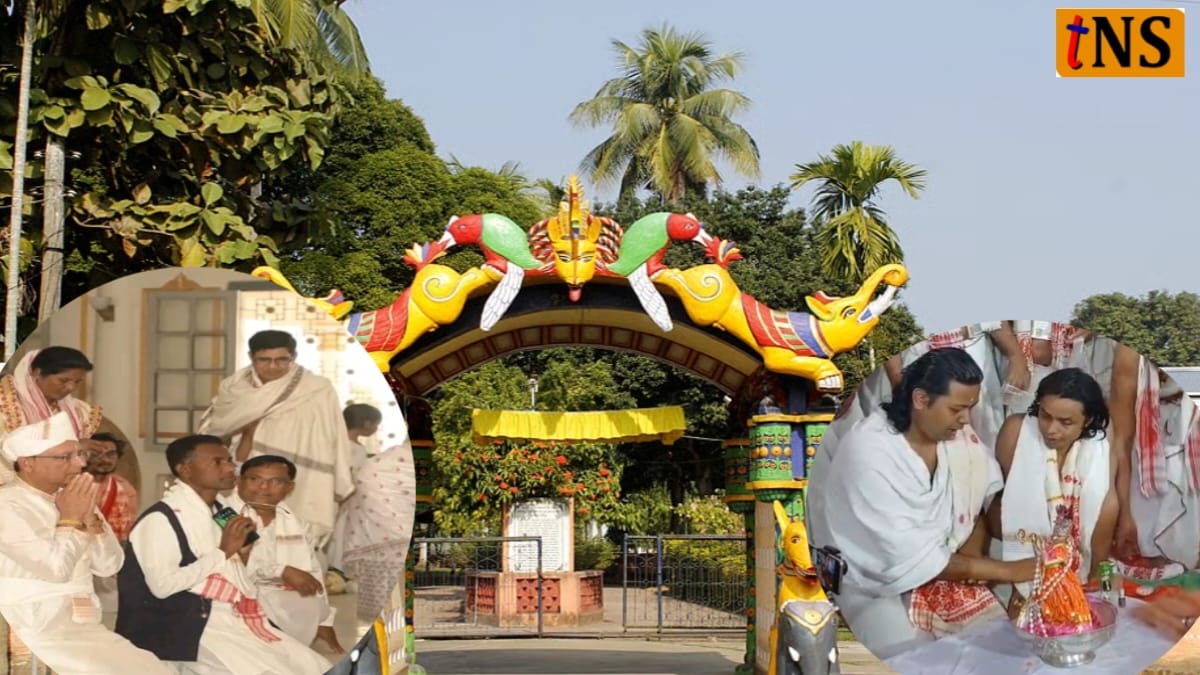
The first day of the festival is observed as Bahnotsav (also called Gandhotsav). As evening falls, the idol of Sri Krishna — Govinda Gosai — is carried in procession by devotees accompanied by Gayan-Bayan to a temporary house near the bank of Akashiganga. Obstacle-removing mantras are recited, and the temporary house, called the Gandh Ghar, is then ceremonially burnt.
Thereafter, Govinda Gosai is brought to ‘Rabhatal’, the decorated pavilion prepared for the Phakuwa. After the ritual bath, the idol is anointed with a specially prepared fragrant oil called Gandhatel. This oil is made days in advance by infusing mustard oil with measured quantities of mithiguti, gandhabirina, pirikafangal, and gathiyan. Devotees wait with quiet hope to receive even a small portion of this sanctified oil. The idol is then dressed in new garments, and the Gayan-Bayan perform the Ramdhemali. Songs such as:
“Vaikunthar Nath Doulrose kore keli”
(“The Lord of Vaikuntha plays joyfully in the Doul festival.”)
and
“Korot gandha bidhi Bihar Gopal”
(“Gopal performs the ritual of fragrance.”)
are sung during the ceremony.
The second day is devoted to applying faku to Gosai. After the ritual bath, fragrant faku is placed upon the idol. The Gayan-Bayan perform the Na Dhemali. Devotees receive the faku as a sacred offering, known as nirmali.
On the third day, devotees accompany Gosai in a procession to the Doul temple, where the idol is circumambulated seven times. The procession then visits the residences of the Satradhikars of Sri Sri Narowa and Sri Sri Shalguri Satras before entering the Kirtan Ghar.
At the threshold of the Kirtan Ghar, a lively and symbolically rich ritual known as Duaar Dhara (door-blocking ceremony)unfolds. Along the procession route, the song:
“Bair huache dekho soi sundar Nandar bala / hate bansi mukhe hasi gole kadambar mala”
(“Look, the beautiful son of Nanda has come outside; flute in hand, a smile upon his face, a garland of kadamba around his neck.”)
is performed. In the Duaar Dhara, Lakshmi — displeased that Krishna had gone to the Doul to play faku without her knowledge — closes the door in displeasure and refuses him entry. A spirited but light hearted exchange of words follows between her attendants and those accompanying Krishna. Where had Govinda gone? Let him remain with Ghunucha, they taunt. Krishna’s companions plead that Ghunucha was merely met along the way. Eventually, through mediation, a suitably humbled Krishna bows his head and enters the Kirtan Ghar, where he is ceremonially installed.
The Uresha section of the Kirtan captures the spirit of the festival with precision:
“Ronge faku khele Chaitanya Banamali / duhate Phalgur gunta sinchant Murari”
(“In joy, Banamali plays faku; with both hands Murari sprinkles the colours of Phalgun.”)
The Doul or Phakuwa festival is not merely a traditional observance. It is a symbol of harmony — universal in character, inclusive in spirit. People of different faiths have gathered here across the generations, and the festival has carried, year after year, a message of peace and communal amity. Bordowa, the birthplace of Srimanta Sankardev and home to Sri Sri Batadrava Than, has long reflected the vision of a larger, more united Assam.
After assuming charge as the District Commissioner of Nagaon district, I gave priority to the preservation, development, and disciplined management of Batadrava Than — revered as the second Vaikuntha. In compliance with the directions of the Hon’ble Court, I undertook the sensitive responsibility of constituting a new management committee for Sri Sri Batadrava Than, making every effort to ensure coordination among all stakeholders. We succeeded. Subsequently, in accordance with public consensus, I also assumed the role of Chief Financial Controller of the management committee. With the blessings of the Guru, the goodwill of the people, and collective cooperation, I remain committed to managing the institution with transparency, discipline, and accountability.
The Doul festival of Batadrava belongs not only to Bordowa or the people of Nagaon district — it is a celebration for all of Assam. In preparing for the festival, attention has been given to cleanliness, health camps, ambulance services, fire safety measures, a control room, police deployment, traffic regulation, clean drinking water, and resting facilities for pilgrims. The aim is that every person who comes may celebrate peacefully and in good order — and that this festival may, in its truest sense, carry forward its message of harmony.
With faith in the Guru’s blessings and the trust of the people, we move forward guided by his ideals of equality, humanity, and service.
Warm wishes to all on the occasion of Doul Mahotsav.