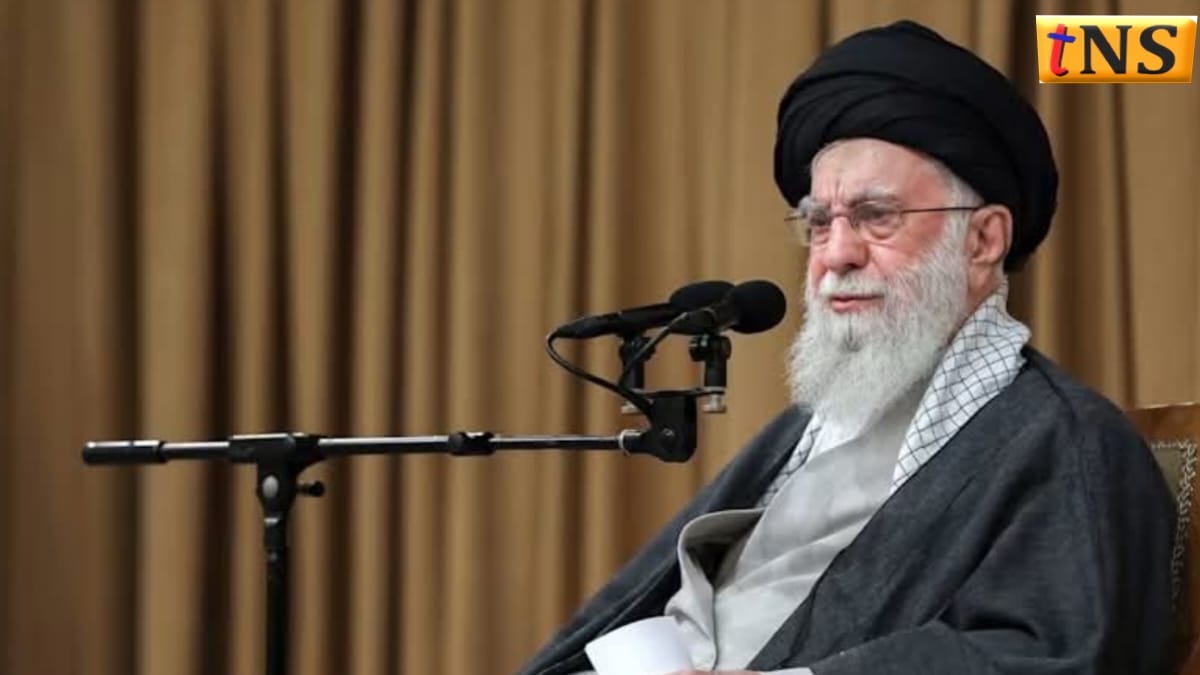
News Desk: Iran’s state media confirmed early Sunday morning that Iran’s Supreme Leader Ayatollah Ali Khamenei has been killed. It has been reported that the incident occurred during an attack carried out by the United States and Israel on Saturday (Iran’s Supreme Leader Ayatollah Ali Khamenei Killed).
Since the beginning of the attack, no statement had been received from Khamenei. Satellite images showed that in the first phase of Saturday’s bombardment, his secured residential compound sustained significant damage.
A few hours after U.S. President Donald Trump announced on his social media platform that Iran’s Supreme Leader had been killed, Iran’s national media acknowledged the truth of the matter. Having served as Supreme Leader since 1989, the Ayatollah’s rule has now ended. According to state media, his daughter, son-in-law, and grandson were also killed.
Ayatollah Ali Khamenei: From Revolutionary to Ruler
Born in 1939 in the holy northeastern Iranian city of Mashhad, Khamenei came from a religious family. His father was a well-known cleric. His mother, Khadijeh Mirdamadi, nurtured in him an early interest in the Quran and literature.
Khamenei began studying the Quran at the age of four and, without completing secondary school, continued his education in religious seminaries. Later, he studied at major Shia centers of higher learning such as Najaf and Qom.
Khamenei’s Political Life
In 1953, a coup carried out with the assistance of MI6 and the U.S. Central Intelligence Agency (CIA) removed the elected Prime Minister Mohammad Mossadegh from power. Like many Iranians, this event politically influenced Khamenei.
While studying in the city of Qom, he was deeply influenced by the ideology of Shia Islam and by the thoughts of conservative opposition leader Ruhollah Khomeini. At the time, Shah Mohammad Reza Pahlavi had launched extensive reform programs in the country, which were opposed by most conservative clerics. In 1978, Khamenei actively participated in the mass movement in Iran that led to the fall of the Pahlavi monarchy and paved the way for the Islamic Revolution.
Thus, from being a simple religious student to ruling as Iran’s Supreme Leader for more than three decades, Khamenei’s political journey became deeply intertwined with Iran’s modern history. Later, as a close associate of Ruhollah Khomeini, he secured high positions in the new governing system.
In 1981, Khamenei survived an assassination attempt carried out by the opposition group Mujahedin-e Khalq (MEK). However, he lost the use of his right hand. The organization had launched an armed rebellion against the newly established Islamic regime. During that time, he was formally elected as President.
After the death of Ruhollah Khomeini in 1989, the constitution was amended to allow a person with lower clerical qualifications to become Supreme Leader, enabling Ayatollah Khamenei to assume the more powerful position. From then on, he became Iran’s Supreme Leader. In the 1990s, he further consolidated his power. To achieve this, he suppressed opponents with a heavy hand, including killings, while rewarding his allies. He also targeted opponents abroad.
For this, he developed ties with militant organizations such as Hezbollah. Behind Ayatollah Khamenei’s power stood the Islamic Revolutionary Guard Corps (IRGC).
In 1997, reformist candidate Mohammad Khatami won the presidency by a large margin. Ali Khamenei granted him a certain degree of freedom. After 2001, when Khatami attempted to improve relations with the United States, Khamenei did not obstruct those efforts. However, after the U.S. invaded Iraq in 2003, Khamenei supported the IRGC in waging a covert war against American forces in Iraq and in expanding Iran’s influence there. As a result, tensions between Khamenei and the United States gradually intensified.
Opposition and Dissent
It is noteworthy that Khamenei suppressed, with a heavy hand, various movements and demands for reform within the country at different times. In particular, he adopted strict policies against women, homosexuals, and religious minorities. He harshly suppressed protests following the disputed presidential election in 2009 and the 2022 protests over women’s rights. During his rule, protests across Iran demanding political and social freedoms were regularly crushed. Unrest caused by economic hardship was also dealt with severely.
Under Khamenei’s leadership, repression against women reached a new level. At the same time, young talents and academics were compelled to migrate abroad. In January of the current year, protests that began over the economic crisis turned into widespread nationwide movements, with many demonstrators demanding the fall of the Islamic Republic. Moreover, the worsening economic situation left even his supporters dissatisfied. According to critics, he gradually distanced himself from the younger generation seeking reform and economic development. The high price paid in the name of preserving Iran’s independence left many citizens disillusioned.
A Self-Proclaimed Divine Representative
As Iran’s highest political and religious leader, Khamenei considered himself a representative of God. Toward the end of 2023, he stated that God spoke through him. He recalled that about 20 years earlier, while delivering an inspirational message to Revolutionary Guard officials accompanying him, “Almighty God was speaking! In fact, it was my tongue, but the words were God’s; it was an extraordinary gathering,” Khamenei claimed, adding that it had a significant impact.
It is notable that Khamenei did not like his decisions to be questioned. He never gave interviews. In 2018, a student who asked on camera whether the Supreme Leader could be questioned was sentenced to two years in prison on charges of “insulting a religious leader.”
Recent Developments
Significantly, Israel and the United States initially aimed not merely to assassinate Khamenei but to bring about the fall of the current governing system of the Islamic Republic of Iran. In October 2024, Khamenei faced intense pressure. A few days earlier, Israel had carried out a major bombing at Hezbollah’s headquarters in Beirut, Lebanon, killing the organization’s experienced Secretary-General Hassan Nasrallah. The incident deeply affected Khamenei, who had maintained a personal relationship with Nasrallah for decades.
On Saturday, as U.S. and Israeli aircraft and missiles struck Iran, Khamenei’s office was targeted and he was reportedly killed. Regarding the death of 86-year-old Khamenei, Israeli Prime Minister Benjamin Netanyahu said on Saturday that many indications suggested Khamenei “is no longer among us,” though he did not explicitly confirm the death. However, after U.S. President Donald Trump also claimed that Khamenei had been killed, Iran’s state media officially confirmed his death.