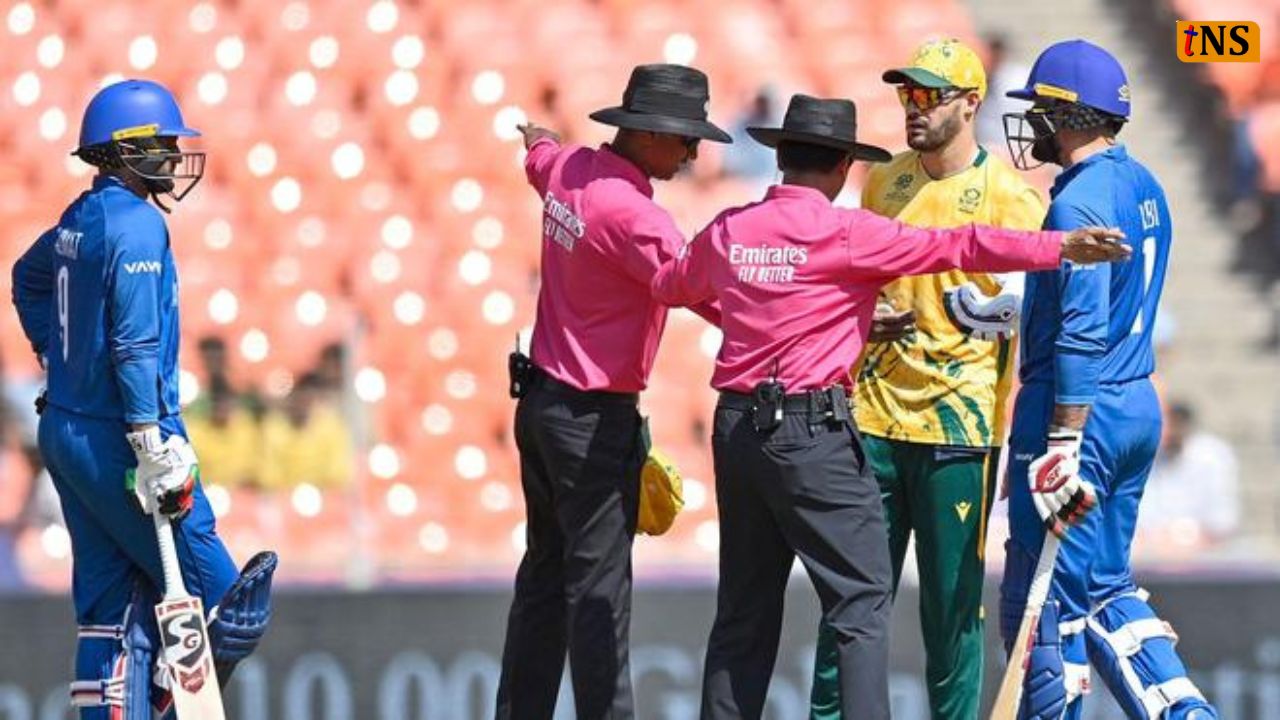
Sports Desk: Afghanistan all-rounder Mohammad Nabi has been penalised by the International Cricket Council (ICC) for breaching the Code of Conduct during his team’s ICC Men’s T20 World Cup 2026 Group D match against South Africa in Ahmedabad on Wednesday (Mohammad Nabi ICC Code of Conduct Breach).
The ICC confirmed that Nabi was fined 15 per cent of his match fee after being found in violation of Level 1 of the ICC Code of Conduct. The charge relates to Article 2.4 of the Code for Players and Player Support Personnel, which concerns “disobeying an umpire’s instruction during an international match.”
In addition to the financial penalty, one demerit point has been added to Nabi’s disciplinary record. It is his first offence within a 24-month period.
The incident occurred at the beginning of the 14th over of Afghanistan’s innings. Nabi became involved in a prolonged exchange with the on-field umpires regarding a wristband worn by South Africa pacer Lungi Ngidi. The conduct was deemed to be a refusal to comply with the umpires’ directions.
Nabi admitted the breach and accepted the sanction proposed by David Gilbert of the Emirates ICC International Panel of Match Referees. As a result, no formal hearing was required.
The charge was levelled by on-field umpires Jayaraman Madanagopal and Sharfuddoula Ibne Shahid, along with third umpire Nitin Menon and fourth umpire K.N. Ananthapadmanabhan.
Under ICC regulations, a Level 1 offence carries a minimum penalty of an official reprimand and a maximum penalty of 50 per cent of a player’s match fee, along with one or two demerit points. Players who accumulate four or more demerit points within a 24-month period face suspension, with two suspension points translating to a ban from one Test match or two ODIs or two T20Is, whichever comes first.
The match itself ended in dramatic fashion. After finishing in a tie, it required two Super Overs to determine the result, with South Africa ultimately securing victory at the Narendra Modi Stadium in Ahmedabad.
A Brewing Storm: Pakistan’s Strategic Pivot and the ICC’s Firm Rebuttal