GAUTAM SARMAH
(gautamsarmah8@gmail.com)
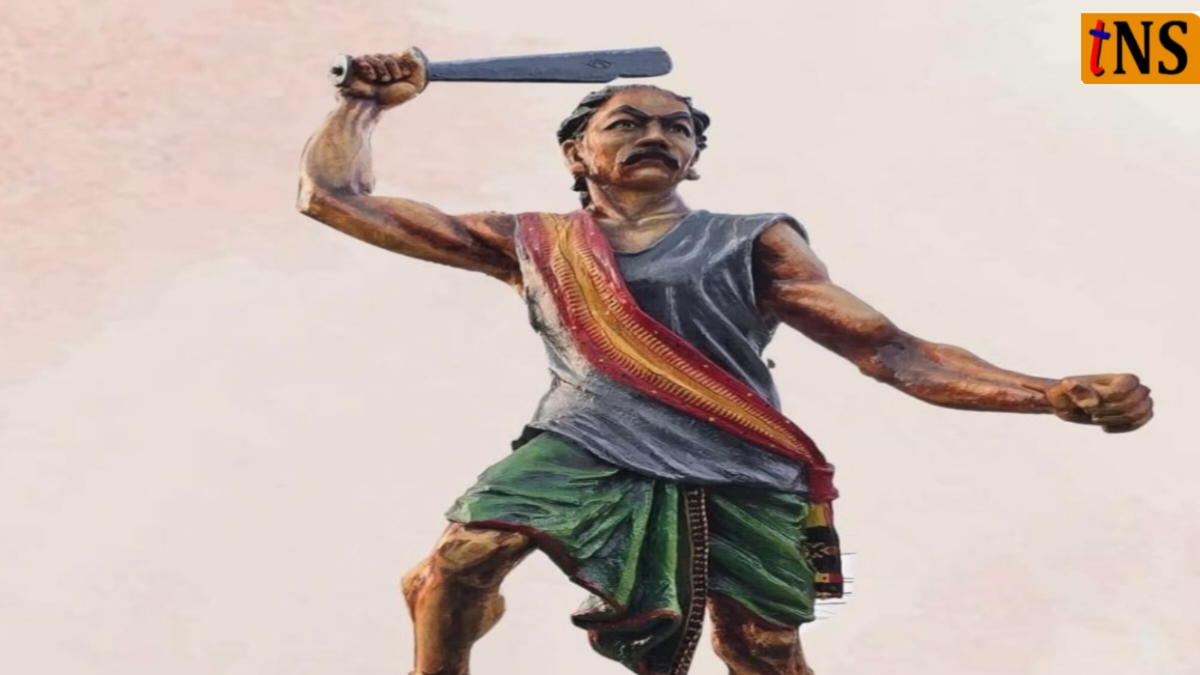
Sambhudhan Phonglo, remembered with reverence as Veer Sengya Sambudhan Phonglo, occupies a unique and heroic place in the history of Assam’s anti-colonial resistance. Born on 16 March 1850 in Longkhor near Maibang in the erstwhile North Cachar Hills, now in Dima Hasao district, he emerged from a remote hill society to challenge the authority of the British Empire with extraordinary courage, vision, and ideological clarity (Veer Sengya Sambhudhan Phonglo). His life, though tragically short, represents one of the earliest organized tribal rebellions against colonial rule in Northeast India, and his ideas on freedom, dignity, and resistance continue to inspire historical scholarship and popular memory alike.
Sambhudhan Phonglo was born into a Dimasa family to Deprondao Phonglo and Khasaidi Phonglo, and grew up with his four younger brothers—Umakant, Ramakant, Ramcharan (also known as Ramren), and Haisholong. His childhood was shaped by the hills and valleys of the North Cachar region, an area rich in indigenous culture, oral traditions, and a strong sense of autonomy. His early movements across Longkhor, Gonjung, Saupra near Nanadisa, and later Semdikhor near Mahur reflect the mobility of hill communities and the gradual widening of his social and political consciousness. His marriage to Nasadi anchored him in the social fabric of his community, but his personality, described as tall, fair-complexioned, with black eyes and large ears, also symbolized his commanding presence and natural leadership among the youth.
The political background that shaped Sambhudhan Phonglo’s consciousness was the gradual expansion of British colonial control over the Cachar and hill regions of Assam. In 1832, the British took control of Southern Cachar, and by 1854 they extended their authority over Northern Cachar. Instead of treating the region as a unified administrative and cultural unit, the colonial authorities fragmented it, annexing it to the district of Nagaon and later distributing parts of the territory between Nagaon and Naga Hills. By 1866, the North Cachar Hills were carved out as a separate territory under indirect colonial administration with a Junior Political Officer headquartered at Asalu. These administrative manipulations were not merely bureaucratic measures; they disrupted traditional political systems, weakened indigenous institutions, and facilitated economic and political control by the colonial state.
Sambhudhan Phonglo perceived these changes with remarkable political insight. He believed that the British had no moral or legal right to rule the indigenous peoples of Assam and that the fragmentation of territories was a deliberate strategy to weaken native unity and resistance. His political philosophy was rooted in a deep sense of freedom and dignity. He argued that losing freedom was equivalent to embracing slavery and that no hardship could be worse than living as a subject under foreign domination. His thoughts resonate with universal anti-colonial ideas, yet they were articulated from within a tribal worldview that valued autonomy, land, and community sovereignty.
Driven by this conviction, Sambhudhan Phonglo decided to organize a rebellion against British colonial power. Unlike spontaneous uprisings that erupted in many tribal regions, his movement showed elements of planning, organization, and ideological mobilization. He traveled extensively across the North Cachar Hills, meeting villagers, youth, and local leaders, spreading the message of resistance, and building a network of followers. His ability to mobilize a large number of youths indicates his charisma and the resonance of his ideas among the hill communities who were increasingly feeling the pressure of colonial administration, taxation, and interference in customary practices.
To give structure to his movement, Phonglo appointed Man Singh as his Principal Adviser and Molongthong as a Subordinate Commander, indicating the emergence of a rudimentary revolutionary command structure. He established a training center at Maibang, where recruits were brought in batches of thirty to forty. Villagers voluntarily supported the movement, providing food, shelter, and other services to the insurgents. This demonstrates that Phonglo’s rebellion was not an isolated act of defiance but a collective assertion of indigenous resistance involving a wide segment of the local population.
Although the details of his military engagements and the eventual suppression of his movement by the colonial authorities are not always fully documented in mainstream historiography, oral traditions and local histories remember him as a fearless warrior who challenged the British at a time when colonial power seemed invincible. His martyrdom on 12 February 1883 marked the end of his life but not the end of his legacy. His struggle stands alongside other tribal and peasant uprisings in India, such as the Santhal rebellion, the Munda movement, and the Khasi and Garo resistances, highlighting the multi-regional and multi-ethnic nature of India’s freedom struggle long before the rise of organized nationalist politics in the early twentieth century.
In post-independence India, Sambhudhan Phonglo has gradually received recognition as a regional freedom fighter and a symbol of indigenous resistance in Assam. Governmental and non-governmental organizations, historians, cultural bodies, and student groups have worked to revive his memory through commemorations, seminars, publications, statues, memorials, and inclusion in local history curricula. Various cultural organizations in Dima Hasao and Assam have organized annual remembrance programs, public lectures, and cultural events to highlight his contribution. His name has been invoked in discussions on tribal rights, autonomy, and the historical role of hill communities in resisting colonial domination.
The Government of Assam and local district administrations have also acknowledged his contribution by including him in the broader narrative of Assam’s freedom struggle and tribal history. Memorials, plaques, and public discussions have contributed to popularizing his legacy among younger generations. Scholars and writers have increasingly focused on figures like Sambhudhan Phonglo to challenge the mainland-centric narratives of Indian nationalism and to emphasize the role of marginalized communities in shaping the anti-colonial movement.
A significant recent development in honoring Sambhudhan Phonglo’s legacy is the initiative by Rabindranath Tagore University, Hojai, to establish a new campus in Dima Hasao district and to honor him through this academic expansion. The decision to recognize Sambhudhan Phonglo in an academic institutional context is highly commendable, as universities play a crucial role in shaping historical consciousness, research, and public memory. By associating his name and legacy with a center of higher learning, the university has symbolically linked indigenous resistance, education, and modern knowledge production. This step not only honors Sambhudhan Phonglo but also validates the historical experiences and contributions of the Dimasa and other hill communities within the academic and intellectual sphere.
The establishment of a Rabindranath Tagore University campus in Dima Hasao itself is a landmark step toward educational development in a historically remote and underrepresented region. Linking this campus with the legacy of Sambhudhan Phonglo sends a powerful message that education, culture, and freedom are interconnected. It acknowledges that the struggle for dignity and autonomy waged by leaders like Phonglo laid the moral and historical foundations for contemporary aspirations for development, education, and social justice. Such initiatives deserve heartfelt appreciation and gratitude, as they bridge the gap between historical memory and present-day institutional recognition.
Sambhudhan Phonglo’s life and struggle also raise important questions about how history is written and remembered. For a long time, the narratives of India’s freedom struggle were dominated by events and leaders from the plains and metropolitan centers, often marginalizing the contributions of tribal and frontier communities. The recovery of figures like Phonglo is part of a broader historiographical effort to democratize history and recognize the plurality of resistance movements across India. His movement illustrates that the idea of freedom was not imported into tribal societies from external nationalist leaders but was deeply rooted in indigenous concepts of autonomy, land rights, and community governance.
His ideological clarity, his assertion that living under foreign domination was equivalent to slavery, shows a sophisticated understanding of colonialism and its implications. His willingness to organize, train, and mobilize people reflects an early form of revolutionary leadership in the hills of Assam. His story also demonstrates the interconnectedness of local grievances and universal ideals of freedom, dignity, and self-determination.
Today, Sambhudhan Phonglo stands as a symbol of courage, resistance, and indigenous nationalism in Assam’s history. His legacy continues to inspire cultural pride among the Dimasa community and contributes to the broader Assamese identity that celebrates diversity, resistance, and unity against oppression. Academic institutions, government bodies, cultural organizations, and civil society groups must continue to research, document, and disseminate knowledge about his life and movement so that his contribution is not confined to regional memory but integrated into national historical narratives.
Sambhudhan Phonglo’s life represents a powerful chapter in the history of Assam and India’s freedom struggle. Born in a remote hill village, he rose to become a visionary leader who challenged colonial authority with courage and conviction. His organized rebellion, ideological depth, and sacrifice make him one of the pioneering tribal freedom fighters of Northeast India. The honors accorded to him by governmental and non-governmental institutions, and especially the recent initiative by Rabindranath Tagore University to establish a campus in Dima Hasao in his honor, reflect a growing recognition of his historical importance. Such initiatives deserve sincere appreciation, as they ensure that the memory of Veer Sengya Sambhudhan Phonglo continues to inspire future generations and remains an integral part of Assam’s and India’s collective historical consciousness.