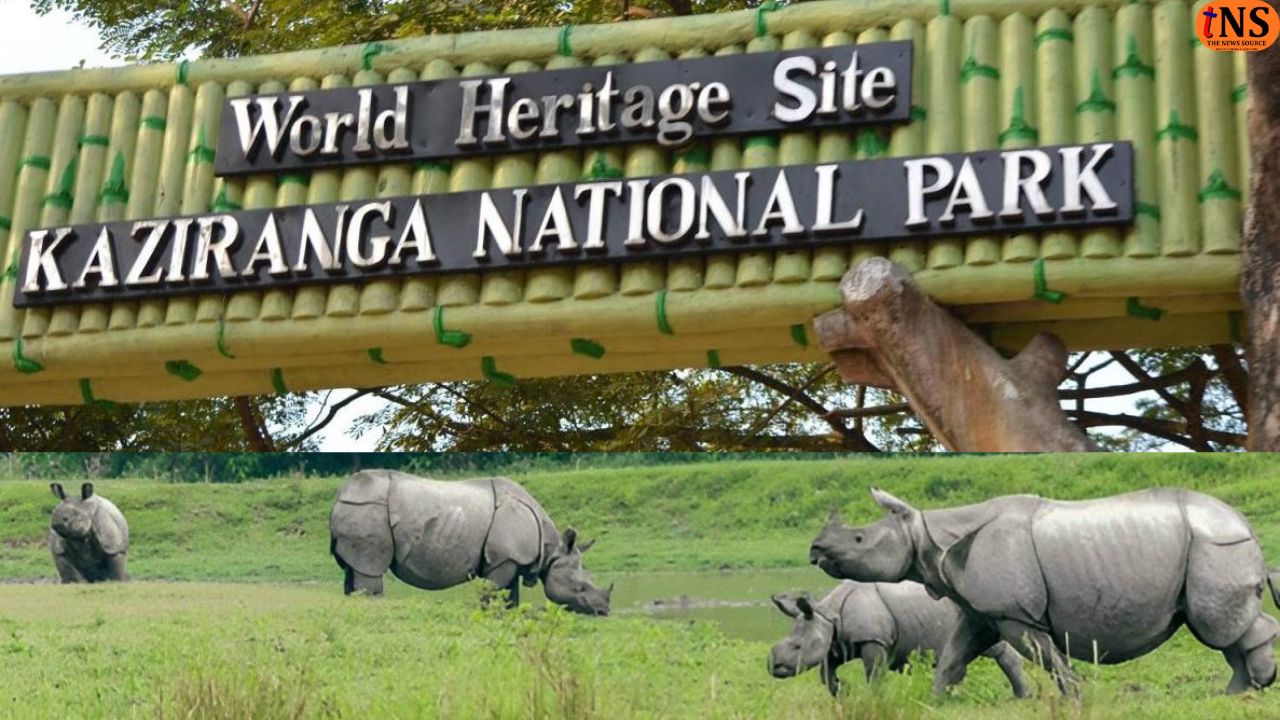
Guwahati / Nagaon: Assam did not record a single incident of rhino poaching in 2025, marking a significant milestone in the state’s long-running conservation efforts, Chief Minister Himanta Biswa Sarma said on Wednesday (Assam Rhino Poaching Free 2025).
Announcing the achievement on social media platform X, Sarma said Assam had successfully continued its streak of protecting the one-horned rhinoceros, an animal widely regarded as the state’s pride.
“From national shame to a moment of national pride, Kaziranga has travelled a long way truly befitting of its status as a World Heritage Site,” Sarma wrote. “For the last two years, there hasn’t been a single instance of rhino poaching, elevating the animal’s safety in the park (Kaziranga rhino protection).”
The announcement coincides with another major benchmark in wildlife protection. Earlier this week, Sarma stated that Kaziranga National Park had completed 730 days—two full years—without a single case of rhino poaching, underlining the effectiveness of focused and continuous protection strategies at the UNESCO World Heritage site (Rhino conservation in Assam).
Assam is home to the world’s largest population of the one-horned rhinoceros, with the majority residing in Kaziranga. Smaller populations are also found in Manas National Park, Orang National Park and Pobitora Wildlife Sanctuary (Kaziranga poaching free).
While 2025 recorded zero poaching incidents statewide, the journey has been uneven in the past. According to official and historical data, Assam lost at least 191 rhinos to poaching between 2000 and 2021. The worst years were 2013 and 2014, when 27 rhinos were killed each year. Incidents declined steadily thereafter, dropping to three cases in 2019, two in 2020 and one in 2021.
In 2022, Assam achieved a breakthrough when no rhinos were poached for the first time since 1977. One rhino death was reported in 2023, followed by two in 2024. In response, the state launched Operation Falcon, a multi-agency crackdown that foiled nine poaching attempts. Police records show that 42 poachers linked to six gangs were arrested in 2024 and 2025.
In June 2021, the Assam government also constituted a Special Anti-Poaching Task Force, bringing together senior officials from the forest and police departments to strengthen coordination and intelligence-based operations (Operation Falcon Assam).
Kaziranga National Park and Tiger Reserve Director Sonali Ghosh said enhanced surveillance—including drone monitoring, CCTV coverage, coordinated patrolling and intelligence sharing—had played a crucial role. She added that heightened vigilance during high-risk periods such as floods and full-moon nights, along with cooperation from local communities living around protected areas, was key to preventing poaching.
In a symbolic move against illegal wildlife trade and superstition associated with rhino horns, the Assam government destroyed 2,479 seized rhino horns on September 22, 2021.
Rhinos are protected under Schedule I of the Wildlife (Protection) Act, 1972, and international trade in rhino horns is banned under the Convention on International Trade in Endangered Species of Wild Fauna and Flora (CITES). Additionally, the Assam Rhinoceros Preservation Act, 1954, and its subsequent amendments provide specific legal protection to the greater one-horned rhinoceros in the state.
Officials said the recent milestones demonstrate that sustained enforcement, community participation and political will can significantly curb wildlife crime in one of India’s most critical conservation landscapes.
Rescue of Stranded Rhino Calf at Burapahar Range