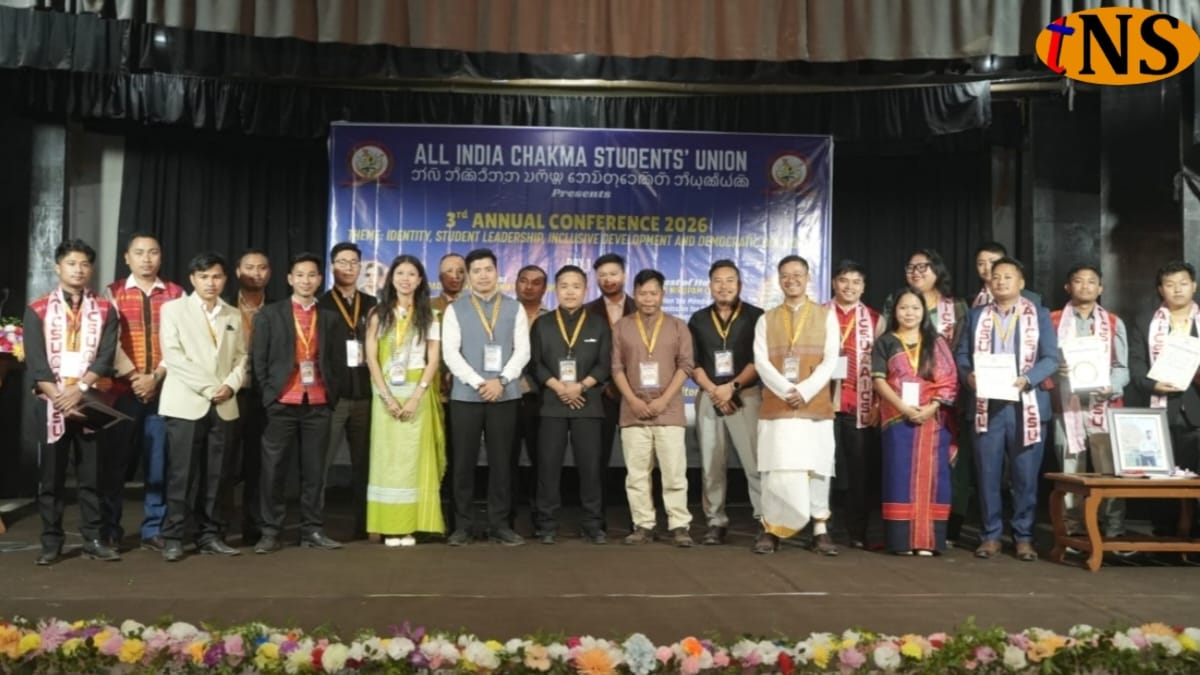
News Desk: Among the oldest and most culturally distinguished communities of Northeast India and South Asia, the Chakmas carry within them centuries of living tradition (AICSU Third Annual Conference 2026). Their Buddhist philosophy, their peaceable way of life, and the quiet resilience with which they have preserved their language, script, and arts through turbulent historical chapters — all of this makes them remarkable. The intricate craftsmanship of their traditional Pinon-Hadi attire and the vibrant celebration of Bizu, their national festival, continue to add a singular richness to the already diverse cultural tapestry of the Northeast. It was in the spirit of honoring this heritage — and weaving it together with modern education and the promise of unity — that a landmark gathering took place on the 6th and 7th of March at Shilpagram, Guwahati.
The Conference: Its Purpose and Organizational Roots
Under the guiding philosophy of “Identity, Student Leadership, Holistic Development, and Democratic Dialogue,” the All India Chakma Students’ Union (AICSU) concluded its two-day Third Annual Conference at the NEZCC auditorium in Shilpagram, Guwahati — and by all accounts, it did so with considerable success.
Founded in 2015, AICSU stands as the apex student organization representing Chakma learners across the length and breadth of India. Under its umbrella, ten affiliate student bodies have come together — spanning Arunachal Pradesh, Mizoram, Tripura, Meghalaya, and the Barak Valley, and reaching as far as the metros of Delhi, Bengaluru, Kolkata, and Chennai. That kind of geographic spread alone tells you something about the scope of what this organization is trying to do.
Pradyot Bikram Manikya Debbarma’s Historic Announcement
The first day of the conference drew particular attention — and for good reason. Pradyot Bikram Manikya Debbarma, scion of the royal family of Tripura and founder of the Tipra Motha party, graced the occasion as the chief guest.
He announced that he would personally fund scholarships for approximately 50 Chakma students every year to pursue higher education — money drawn directly from his own private resources, not from any government scheme or institutional fund. A personal commitment. A deliberate one.
Encouraging students to strive relentlessly toward excellence, he did not shy away from the political either. He stated plainly: “India is incomplete without the Chittagong Hill Tracts.”
He called upon the people of the entire Northeast to speak out — without fear — against the human rights violations being perpetrated against the indigenous communities of that region. Also present that day were Nirupam Chakma, member of the National Commission for Scheduled Tribes (NCST), as guest of honour, and Molin Kumar Chakma, former CEM of CADC in Mizoram, who addressed the gathering as the keynote speaker.
Inspiration, Ideas, and Intellectual Exchange
The second day brought its own energy. Santana Chakma, Cabinet Minister of Tripura, took the stage as chief guest and spoke from a place of hard-won personal experience. Her message was direct, unvarnished: “Abandon negativity. Dedicate yourself to the service of society.” Sometimes the simplest words carry the most weight.
Somlung Mossang, former MLA from Arunachal Pradesh, and Dr. Pawan Tiwari, Organizational Secretary of the Vidya Bharati for the Northeast region, joined as distinguished guests. Dr. Tiwari’s remarks centered on something increasingly urgent — the indispensable role that education plays in building a society that is not just functional, but genuinely healthy.
Woven through the conference were four substantive panel discussions that tackled issues both immediate and long-standing. The first focused on entrepreneurship and self-reliance among Chakma youth. The second examined opportunities in higher education and how to access them. The third addressed Geographical Indication (GI) tagging for traditional Chakma textiles and dress. The fourth took up the implementation of the Chittagong Hill Tracts Peace Accord — a conversation as necessary as it is unresolved.
A New Hope, Quietly but Firmly Taking Root
The conference closed in a mood of cultural warmth and forward-looking resolve. AICSU President Drishyamuni Chakma, reflecting on the two days, said that the event had breathed new hope into Chakma youth. The scholarships announced by Pradyot Debbarma, in particular, are expected to open real doors for talented students who might otherwise have found those doors firmly shut — students for whom financial constraint has long been the invisible ceiling on their ambitions.
Sometimes conferences are just events. This one felt like something else. The conference ended. But for the young men and women who filled that auditorium, something was just beginning.
Nagaon District Sahitya Sabha Holds Mid-Term Session; Proposes “One Book a Month” Reading Campaign