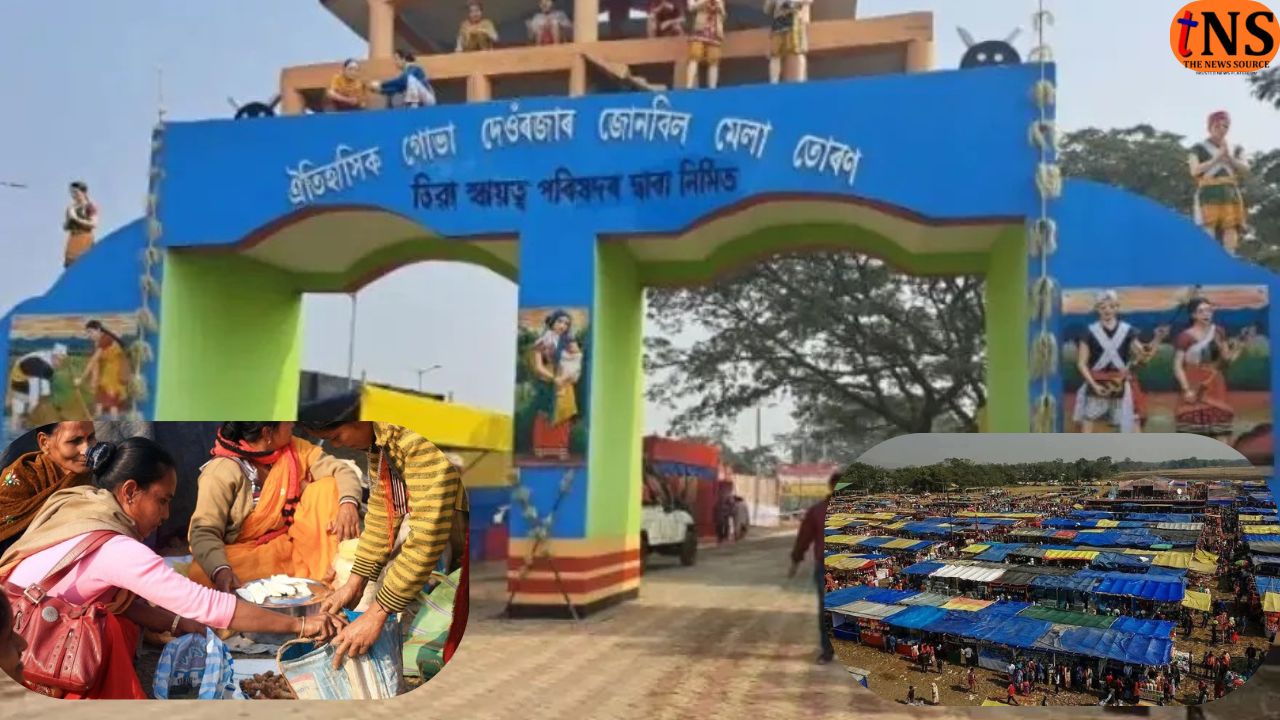
Special Report : The global economy is currently a digital blur of UPI transactions and fluctuating inflation rates. Yet, on the banks of a crescent-shaped lake in Morigaon, time refuses to move (Jonbeel Mela barter system).
Every year, in the week following Magh Bihu, the shores of Jonbeel awaken. It is a moon-shaped body of water near Jagiroad that lends its name to a gathering that functions less like a modern market and more like a living memory of the 15th century.
Here, money is secondary. Sometimes, it is irrelevant.
The Historical Tapestry
The history of Jonbeel Mela is a deep well, stretching back over five centuries. Its existence is inseparable from the political and social evolution of the old Gobha Kingdom, beginning roughly around the 15th century under the patronage of the Gobha Kings.
To understand the mela is to understand the folklore that gave the lake its name. Several layers of memory exist here:
- The King’s Reflection: One popular legend tells of the founder of the Gobha Kingdom (identified by many as King Ponteswar). While returning from a stroll with his queen on a bright, moonlit night, he stopped by a vast body of water. The reflection of the full moon in the clear water was so striking that the King immediately named it Jon-er-beel—the Lake of the Moon. The Tiwa Roots:
Linguistically, the name has a more indigenous grounding. In the Tiwa language, ‘Jon’ is Chonai and a lake is Pil. It is believed the King, moved by the sight, exclaimed, “Hebe Chonai Pil Hongdo” (This is a lake like the moon). Over generations, Chonai Pil softened into Jonai Pil, eventually becoming the Assamese Jonbeel.
- The Sickle Shape: A more literal interpretation looks at the earth itself. The lake is naturally shaped like a crescent or a sickle moon, a geographical quirk that likely cemented its name. A Royal Coronation: Some researchers point to a powerful Tiwa King named Jon Sing. It is said his elaborate coronation took place on these banks, and the mela was established to commemorate his reign. A Union of Kingdoms: Another narrative follows the romance of the Tiwa prince Langbar and the Jaintia princess Hilali. After their union, the Jaintia King granted them a kingdom along the Gobha River. Langbar’s coronation reportedly took place seven days after Magh Bihu, marking the inception of the gathering.
The Ahom Influence:
During the era of the Ahom reign, the mela took on a strategic dimension. The Ahom monarchs recognized the site as a Milan Bhumi—a meeting ground. It was used as a neutral space to strengthen ties with the hill kingdoms and to discuss border trade and political stability between the various powers of the region.
The Harvest Feast:
Others view the mela as a public expansion of the Gobha King’s No-khowa (new harvest) festival. After the crops were gathered, the people of both the hills and the plains would congregate to feast together. What began as a communal meal evolved over the centuries into the massive exchange of goods and culture seen today.
The Barter:
The core of Jonbeel Mela remains the barter system. It is perhaps the only place left in the country where large-scale commerce happens through a simple hand-to-hand exchange of goods.
People descend from the hills—Tiwa, Karbi, Khasi, and Jaintia communities—whom the plains-dwellers address with the familiar affection of Mama-Mami (maternal uncles and aunts). They bring what the high ground yields: ginger, turmeric, wild roots, pumpkins, dried chilies, and black pepper. They carry bundles of cotton and medicinal herbs like shilikha ( Black Myrobalan ) and amlokhi (Indian Gooseberry).
In return, the people of the plains offer what the hills lack: pithas, handoh, puffed rice, and fish—both fresh and dried—caught from the Jonbeel itself.
There is no aggressive haggling. No calculators. The exchange is a quiet negotiation based on a shared understanding of need. A handful of turmeric for a handful of roasted rice. The satisfaction in these transactions isn’t about profit margins; it is about a social bond that predates the invention of the banknote. While modern markets turn people into consumers, Jonbeel keeps them as neighbors.
A Kingdom Without Power, a King with Presence:
Even now, in a democratic age where royal administrative power has long since vanished, the Gobha Deo-Raja remains the central gravity of the event.
The current King, Deepsing Deo-Raja—who took the throne at the age of seven—holds a traditional court during the mela. He collects a symbolic ‘tax’ from his subjects. It is a ritual of recognition, a brief window where an ancient political structure is reenacted with dignity.
The Social Bridge:
Before the trading begins, an Agni Puja ( worshiping fire) is performed. Then comes the communal fishing. The King and his officials cast the first nets to catch the Raja Maach (the King’s fish). Only after this ritual is the lake opened to the public. Thousands dive into the water, regardless of caste or tribe.
On the banks, the people from the hills build temporary thatch huts. They live there for the duration of the mela. At night, the air between these huts is filled with talk—stories of the year’s harvest, the struggles of the hills, and the songs of different tribes.
When the mela ends, these huts are set on fire. It is a clean break. As the thatch turns to ash, the hill people begin their trek back home, carrying the promise to return next winter.
Beyond the Market:
For the Tiwa people, Jonbeel is the backbone of their spiritual life. The mela is inextricably linked to the Sogra Puja held in the month of Phagun.
The dried fish and betel nuts exchanged at the mela are not merely food; they are preserved and later offered to the family deities and ancestors during rituals at the No-Bar (the Great House). The items traded at the lakeside eventually find their way to the foot of the Khundakang (the sacred main pillar), connecting the marketplace to the altar.
The Modern Encroachment:
It would be untruthful to say the modern world hasn’t arrived. A segment of the mela now looks like any other fair, with stalls dealing in cash and plastic goods. The state government has also stepped in, providing a ceremonial pension to the Tiwa Kings, a move that provides official recognition to a fading lineage.
Yet, the soul of the event remains in the exchange of goods. Jonbeel Mela poses a quiet, uncomfortable question to the modern visitor: in gaining the ability to buy anything with a screen tap, have we lost the ability to trust a stranger?
The mela is a rare instance where tradition dictates the economy, rather than the other way around. It is a reminder that outside the mechanical grind of modern life, there is still a place where a handful of ginger is worth exactly a handful of friendship.
Jonbeel Mela Day Two Showcases Age-Old Barter Practice