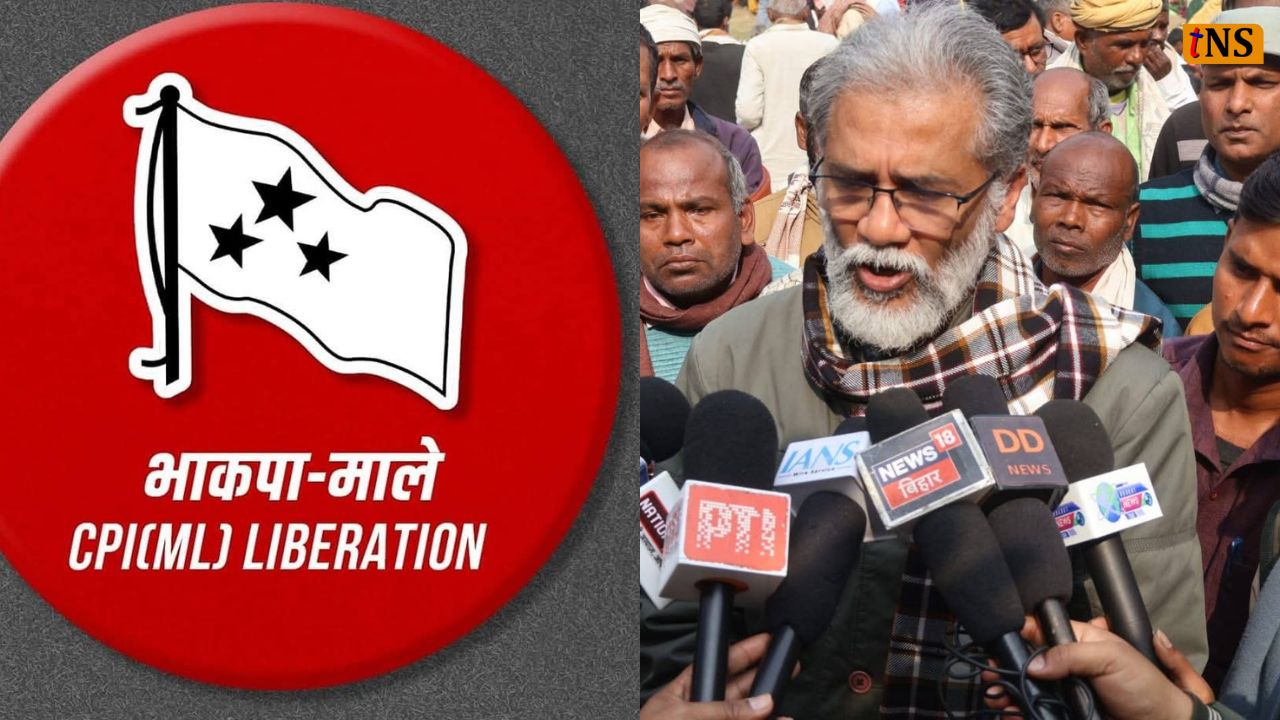
News Desk: Labeling the Union Budget as “hollow,” the CPI (ML) has called for a nationwide strike on February 12. Addressing a press conference in Kolkata on Wednesday, CPI (ML) General Secretary Dipankar Bhattacharya said that instead of reducing the tax burden on ordinary citizens, the budget has granted concessions to big businesses (CPI ML Nationwide Strike February 12). He said all opposition political parties should strongly protest against this. He also warned that the Modi government’s India–US trade deal would have adverse effects on Indian farmers. In protest, CPI (ML) has called for a nationwide strike on February 12.
Speaking on behalf of CPI (ML), General Secretary Dipankar Bhattacharya said, “Information coming from the United States suggests that the trade deal with India has already been finalized. However, the statements from the Modi government and the US differ. From India’s side, it is being projected as if we have conquered the world. But statements from Trump clearly show that the US will gain entirely from this deal. Indian goods will face an 18 percent duty, while goods sold by the US in India—including agricultural products—will have zero duty. That means zero for us, 18 for them.”
He further said, “Under this agreement, oil imports from Russia will stop. Oil will now come from the US and from Venezuela, where control will rest with the US. What we are hearing about the full agreement is extremely worrying and objectionable for India. The Indian government must clearly state the terms under which this deal has been signed.”
Raising questions about the budget, Bhattacharya said, “At a time when the value of the rupee is continuously falling and India’s position in global trade is extremely precarious, the budget claims its biggest achievement is cutting expenditure. If expenditure is cut without increasing income, revenue will fall. The key issue was increasing income. GST and personal income tax have become the government’s main sources of revenue. Instead of increasing corporate tax to raise income, corporate tax has been reduced. On the other hand, sectors where spending needed to be increased have not received adequate investment. Education should receive 6 percent of GDP, which has not happened for a long time. Health was supposed to receive 5 percent of GDP, but currently only around 2 percent is being spent.”
CPI (ML) Alleges Modi Government Mortgaged India’s Interests to Trump’s Mega Agenda Through US–India Trade Deal
Meanwhile, CPI (ML) has alleged that through the US–India trade deal, the Modi government has mortgaged India’s interests to Trump’s “mega agenda.”
In a statement, the party’s Central Committee said that the so-called “trade deal” between the US and India was first revealed by US President Donald Trump on social media. After that, Prime Minister Narendra Modi shared only vague and incomplete information on X (formerly Twitter). The statement said that such conduct on an issue so crucial to the country’s future appears to be an attempt to mislead the public.
The statement alleged that the actual terms of the Trump–Modi understanding are still unclear. It said the Prime Minister has only spoken about an 18 percent duty on Indian goods, while Trump himself has stated that India has agreed to stop buying oil from Russia and increase imports from the US and Venezuela. At a time when the US is trying to bring Venezuela’s oil resources under its control, this decision is particularly worrying.
Referring to Trump’s claim that India has agreed to open its market at zero duty for American goods, especially agricultural products, the statement noted that US Agriculture Secretary Brooke Rollins has publicly thanked Trump, saying the move would ensure huge gains for American farmers. It then asked: who benefits from this deal? Why has the Modi government mortgaged Indian farmers and national interests to Trump’s mega agenda?
The statement warned that if American corn, soybeans, ethanol, dairy products, meat, and processed food are allowed to freely enter the Indian market, India’s agricultural sector will face a severe crisis. Millions of small and marginal farmers, already struggling due to rising costs and reduced government support, will be pushed into deeper trouble.
It also pointed out that crucial sectors like steel and aluminum have been kept outside the so-called reciprocal tariff framework, meaning Indian exporters in these sectors will continue to face high duties. Before Trump’s aggressive tariff policies, the average US tariff was just 2.5 percent, which later rose to as high as 50 percent. In this context, the 18 percent tariff deal is not beneficial for India.
According to CPI (ML), what the Modi government is projecting as a major success will, in reality, push rural India—on which more than half the country’s population depends—into a deep economic crisis. MSMEs will be forced to compete with large American corporations, threatening the collapse of the “Make in India” and “Made in India” initiatives.
The statement further said that the deal reflects a gradual erosion of India’s sovereignty in favor of US geopolitical interests. Over the past year, the US share in India’s oil imports has nearly doubled. In such a situation, committing to buy oil from Venezuela under US direction or promising not to buy oil from Russia and Iran is an attack on India’s sovereignty.
Demanding that the government immediately disclose full details of this deal as well as the trade agreement with the European Union, the statement said CPI (ML) would firmly build resistance against any step that harms farmers, working people, and India’s sovereignty.
A Continental Pivot: India Embraces Europe Amid Rising Tensions with Trump