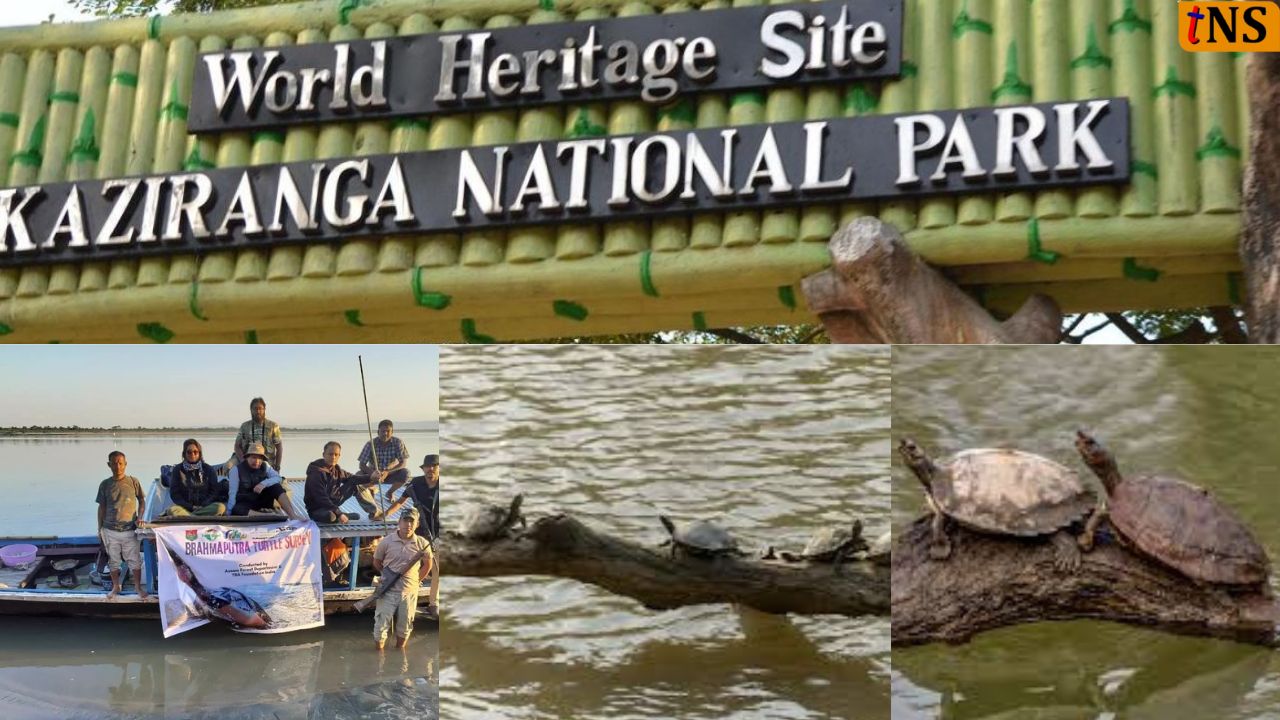
KAZIRANGA, ASSAM : Not only does the Brahmaputra flow across Assam, it supports survival for rare reptile species. During early January, spanning five days, researchers from Kaziranga National Park and Tiger Reserve joined forces with the India Turtle Conservation Programme (ITCP) to survey 174 kilometers of waterway (Kaziranga Turtles Survey).
This journey marked their fifth yearly check. Evidence gathered confirms once again that this zone holds exceptional importance for turtle conservation worldwide, documenting 945 individuals across seven distinct species.
A Census of India’s Chelonian (Shelled Reptile) Diversity
Among those recorded, 945 turtles emerged from the data. Most belonged to hardshell types—specifically 876. Softshells made up the remainder, totaling 69. Within a region supporting nearly half of India’s known Chelonian diversity, such figures quietly reflect an unseen ecological rhythm.
Shadows on the Sandbanks: Tracking Endangered Species
Not far from the river’s edge, quick trips by motorboat allowed close observation of subtle signs. Though researchers counted 55 clear views of hardshell turtles belonging to the Pangshura group, attention often turned instead to traces hidden in damp soil. Evidence emerged slowly—six separate paths where nests had been dug, each shaped by nail markings and trail patterns typical of female Pangshura dragging across soft banks.
What stood out was the data on softshell turtles. Thirteen observations emerged during the survey—nine belonging to Nilssonia gangetica, while four involved the critically endangered Black Softshell turtle (Nilssonia nigricans). Images confirmed each case, an essential step when tracking animals endemic (found only) to the Brahmaputra region, where shrinking habitats and predators persistently threaten survival.
The Guardians of Nagshankar: Community-Led Stewardship
Here, saving nature does not rest only on government shoulders. Near the Nagshankar Temple in Biswanath district, residents have built their own way of guarding life. Thirteen kinds of turtles find shelter in a sacred pond watched closely by neighbors known as Kaso Mitras (Turtle Friends).
Vigilance: Kaso Mitras patrol for eggs threatened by predators like mongooses.
Controlled Incubation: From fragile nests, eggs move into monitored settings for hatching. Placement occurs under regulated conditions where temperature-controlled units support growth, bypassing the risks of the wild.
Rewilding: Upon completion of medical and neonatal (newborn) support, young reptiles go back into natural habitats. Though small at release, they adapt quickly to wilderness conditions.
Restoring River Vitality
Through the collaboration of the temple, Assam Forest Department, and TSA Foundation India, over six hundred turtles have been returned to natural habitats. Recently, 220 young hatchlings began their lives in the wetlands at Sildubi and Roumari Beel.
Beyond the count, such acts support river health. Because these reptiles perform a vital scavenging role—feeding on decaying matter—their presence stabilizes underwater life, ensuring the Brahmaputra remains a healthy lifeline for the communities that depend on it.
Assam Records Zero Rhino Poaching in 2025; Kaziranga Marks Two Years Poaching-Free