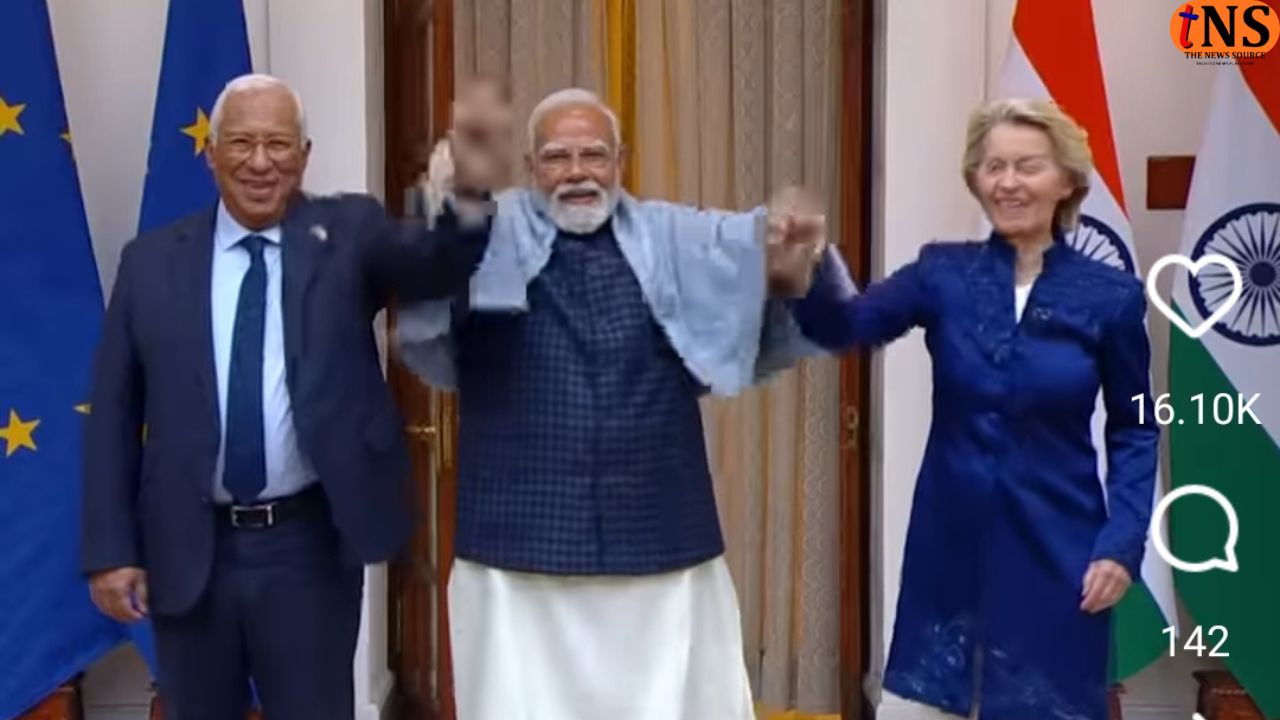
News Desk: The signing took place in the presence of Antonio Costa, President of the European Council, and Ursula von der Leyen, President of the European Commission (India EU Free Trade Agreement). This diplomatic milestone comes at a friction point in Indo-American relations. Roughly a month ago, U.S. President Donald Trump imposed a 50% tariff on Indian exports in retaliation for India’s continued oil imports from Russia, followed by a more recent threat to escalate those tariffs to a staggering 500%. By finalizing this deal, New Delhi has effectively signaled that it will not be deterred by aggressive protectionist policies from the United States (EU Trade Deal).
Anatomy of the Union
The European Union is a powerful political and economic bloc comprising 27 member nations:
Austria, Belgium, Bulgaria, Croatia, Cyprus, Czech Republic, Denmark, Estonia, Finland, France, Germany, Greece, Hungary, Ireland, Italy, Latvia, Lithuania, Luxembourg, Malta, Netherlands, Poland, Portugal, Romania, Slovakia, Slovenia, Spain, and Sweden .
Spanning over 4.2 million square kilometers, the Union is not merely a trade entity; it was awarded the Nobel Peace Prize in 2012 for its role in maintaining peace and stability across the continent.
India’s Strategic Gains: Textiles, Tech, and Talent
India’s primary objective with this FTA is to secure unfettered access for its labor-intensive industries. The withdrawal of the Generalized System of Preferences (GSP) in 2023 left several Indian sectors vulnerable (Modi Europe Strategy). This new agreement aims to revitalize:
Manufacturing & Craft: Textiles, ready-made garments, leather goods, and gems and jewelry.
Engineering & Food: Processed foods and heavy engineering exports.
Services & Mobility: Easier visa regulations for skilled professionals, enhanced access for IT services, and exemptions from dual social security contributions (India US Trade Tensions).
Notably, the Indian government has maintained a protective shield over its domestic agricultural and dairy sectors, excluding them from the deal to safeguard the interests of local farmers.
The European Advantage: Luxury Cars and Fine Spirits
For the European Union, the agreement opens the gates to one of the world’s fastest-growing major economies. The most immediate impact for Indian consumers will be felt in the luxury market.
Currently, European wines and spirits face import duties ranging from 150% to 200%. This agreement paves the way for a gradual reduction in these taxes. Similarly, the automotive sector is set for a transformation. Import duties on high-end vehicles (those priced above €15,000 or approximately ₹16.26 lakh), which currently sit at 110%, are expected to drop to roughly 40% (European Union Market).
This shift is anticipated to significantly lower the price tags on European marques such as BMW and Mercedes-Benz in the Indian market. Beyond luxury goods, the deal streamlines trade for chemicals, medical equipment, and electronics.
“The Mother of All Deals”
The road to this signing was paved by eighteen years of intermittent negotiations, dating back to 2007. Despite the ink being dry, the full implementation of the FTA is expected to be a gradual process, likely reaching its peak by 2027.
Prime Minister Modi hailed the partnership as a unique example of cooperation between two of the world’s major economies. Together, the partners represent 25% of the global GDP and one-third of global trade. Ursula von der Leyen echoed this sentiment, joining the Prime Minister in labeling the pact the “Mother of All Deals.”
A Growing Chasm with Washington
The geopolitical subtext of this deal cannot be ignored. As India seeks alternative markets to offset losses from American tariffs, a parallel drama is unfolding in Europe. President Trump has found himself embroiled in tariff disputes with several European nations, further straining transatlantic relations.
Analysts suggest that by forging this close bond with Europe, India is insulating itself from American volatility. However, this pivot may come at a cost, potentially deepening the diplomatic distance between New Delhi and the Trump administration.
Trump Invites India to Join Gaza Board of Peace as US Unveils Phase Two Framework